

The One Big Beautiful Bill Act (OBBBA), signed July 4, 2025, introduced significant changes across the Direct Student Loans, Direct Parent PLUS Loans, and the Direct Graduate PLUS Loan that are effective beginning with Fall 2026. The final rules were published in May 2026, which is unusually late for changes that are effective in Fall 2026. Colleges and universities are still awaiting additional written guidance from the U.S. Department of Education on several aspects of implementation.
The information on this page represents our understanding of the new regulations as of June 2, 2026. Updates will be made to this website as new details are released.
Undergraduate Students
Direct parent plus loan limits
There are new caps on Direct Parent PLUS Loans for borrowers who start loans after July 1, 2026.
| Undergraduate Direct Parent PLUS Loan | |
| Annual Maximum (total amount that can be borrowed per year) | Aggregate Maximum (total amount that can be borrowed across all years) |
| $20,000 per dependent student | $65,000 per dependent student |
(If you started your program before July 1, had a Direct Loan prior to July 1, 2026, and maintain continuous enrollment in the same academic program at the same institution, you may be subject to a legacy provision which would make you exempt from new rules. Learn more about the legacy provision.)
direct loan ADJUSTMENTS FOR LESS THAN FULL-TIME ENROLLMENT
Under the rules prior to OBBBA, students enrolled at least half-time could often receive close to their full annual loan eligibility.
Beginning in fall 2026:
- Your loan eligibility is directly tied to how many credits you take.
- Less than full-time = smaller loan amount.
- UNCG must apply a “Schedule of Reductions” to all Direct Student Loans based on your enrollment over the academic year.
- UNCG must re-assess your Schedule of Reductions at the time of each Direct Loan disbursement during the academic year.
What you need to know:
- This applies to all Direct Student Loan borrowers; there is no exception.
- Dropped or withdrawn courses that occur after a Direct Student Loan disbursement do not count toward enrollment total at the time of the next disbursement. This could result in a reduction in Direct Student Loan in the next semester.
- Decisions to drop or withdraw should be made only after careful consultation with your academic advisor AND a financial aid counselor.
Important Implications:
- Enrolling less than full-time means your Direct Loans will be reduced so you may need to plan to cover some costs with other sources.
- Enrollment changes now matter more than ever.
- Enrollment changes include dropped and withdrawn courses that happen after the Direct Loan is disbursed.
- Dropped or withdrawn courses in fall means you may receive a smaller loan in the spring.
- Half-time enrollment is still required to receive Direct Loans.
- Undergraduates must be enrolled in at least 6 credit hours.
- Limitations based on need, cost of attendance, and aggregate limits still apply.

The following is an example of a dependent undergraduate Junior level student who enrolls in 6 credit hours for fall and spring. This scenario assumes that the student does not drop or withdraw from any courses for either semester.
| Full-time limits | Reduced limits at 6 credits each semester | |||||
| Fall | Spring | Total | Fall | Spring | Total | |
| Direct Subsidized Loan | $2,750 | $2,750 | $5,500 | $1,375 | $1,375 | $2,750 |
| Direct Unsubsidized Loan | $1,000 | $1,000 | $2,000 | $500 | $500 | $1,000 |
Graduate Students
direct graduate unsubsidized loan limits
There are new, lower limits on borrowing for graduate-level programs vs professional-level programs. All of UNCG’s degree options are considered as “graduate-level” programs by the OBBBA. New annual limits stay the same, but overall aggregate (lifetime) limit will decrease.
| Pre-OBBBA | OBBBA | |||
| Before 7/1/2026 | After 7/1/2026 | |||
| Annual Limit | Aggregate Limit | Annual Limit | Aggregate Limit | |
| Graduate | $20,500 | $138,500 | $20,500 | $100,000 |
Direct Graduate PLUS Loans
Graduate PLUS Loans will no longer be offered after July 1, 2026.
If you started your program before July 1, had a Direct Loan prior to July 1, 2026, and maintain continuous enrollment in the same academic program at the same institution, you may be subject to a legacy provision which would make you exempt from new rules. Learn more about the legacy provision.
Direct Loan ADJUSTMENTS FOR LESS THAN FULL-TIME ENROLLMENT
Under the rules prior to OBBBA, students enrolled at least half-time could often receive close to their full annual loan eligibility.
Beginning in fall 2026:
- Your loan eligibility is directly tied to how many credits you take.
- Less than full-time = smaller loan amount.
- UNCG must apply a “Schedule of Reductions” to all Direct Student Loans based on your enrollment over the academic year.
- UNCG must re-assess your Schedule of Reductions at the time of each Direct Loan disbursement during the academic year.
What you need to know:
- This applies to all Direct Student Loan borrowers; there is no exception.
- Dropped or withdrawn courses that occur after a Direct Student Loan disbursement do not count toward enrollment total at the time of the next disbursement. This could result in a reduction in Direct Student Loan in the next semester.
- Decisions to drop or withdraw should be made only after careful consultation with your academic advisor AND a financial aid counselor.
Important Implications:
- Enrolling less than full-time means your Direct Loans will be reduced so you may need to plan to cover some costs with other sources.
- Enrollment changes now matter more than ever.
- Enrollment changes include dropped and withdrawn courses that happen after the Direct Loan is disbursed.
- Dropped or withdrawn courses in fall means you may receive a smaller loan in the spring.
- Half-time enrollment is still required to receive Direct Loans.
- Graduate students must be enrolled in at least 4.5 credit hours.
- Limitations based on cost of attendance and aggregate limits still apply.

The following is an example of a graduate student who enrolls in 6 credit hours for fall and spring. This scenario assumes that the student does not drop or withdraw from any courses for either semester.
| Full-time limits | Reduced limits at 6 credits each semester | |||||
| Fall | Spring | Total | Fall | Spring | Total | |
| Direct Unsubsidized Loan | $10,250 | $10,250 | $20,500 | $6,833 | $6,832 | $13,665 |
Professional Students
Students in professional programs have higher borrowing limits for Direct Loans under the new rules. The specific degrees qualifying under professional programs have been defined under OBBBA as those generally at doctoral level, requiring ≥6 academic years, licensure, and that fall within specific CIP codes per the U.S. Department of Education. UNC Greensboro does not currently offer any programs that are classified as professional level programs based on the U.S. Department of Education definitions. UNCG is aware that there is currently litigation over the definition of professional programs as defined by the U.S. Department of Education. We will update this site and inform affected students if there is any change to this rule.
Overall Lifetime Borrowing Cap
Across all loans during a student’s lifetime, there is a Direct Loan borrowing limit of $257,500. Parent PLUS Loans are not counted toward a student’s lifetime limit.
Legacy Provision
The legacy provision (also referred to as the interim exception or grandfathering) requires certain continuing borrowers to continue borrowing under the rules that existed before the OBBBA for a limited time.
Undergraduate students under legacy
- Direct Parent PLUS Loan has no annual or aggregate limit, but is still limited by remaining cost of attendance
Graduate students under legacy
- Direct Unsubsidized Loan has an aggregate limit of $138,500. All Direct Loans borrowed by the student count toward this limit.
- Graduate students may borrow Direct Grad PLUS Loan
Legacy status is determine by UNCG based on four specific criteria.
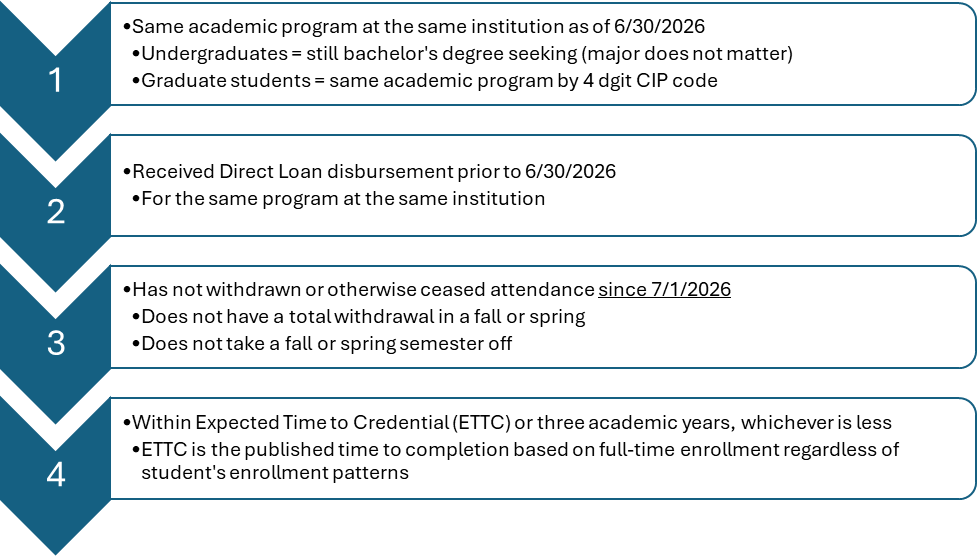
More info on Expected Time to Credential
UNCG will be calculating both the expected time to credential and the time completed by students as of 6/30/2026. UNCG’s academic year includes fall and spring as mandatory and summer as optional.
The federal definition of expected time to credential for the purposes of legacy determination is the published length to credential based on full-time enrollment.
- Expected Time to Credential
- Undergraduate students = 4 years
- Time Completed toward Credential
- UNCG is required to count transfer credits accepted by UNCG toward the time completed.Every semester of enrollment in fall or spring counts as a semester completed.
Federal rules mandate that students qualify for the legacy provision for the remaining time to completion of credential or three academic year, whichever is less.
Example:
Undergraduate admitted fall 2024 as a first time in college student
| Enrollment | Time to Credential |
| Fall 2024 + Spring 2025 | Year 1 |
| Fall 2025 + Spring 2026 | Year 2 |
| Fall 2026 + Spring 2027 | Year 3 |
| Fall 2027 + Spring 2028 | Year 4 |
On 6/30/2026, UNCG determines that the student has 2 years of remaining time to credential. Since that is less than 3 years, the student is subject to the legacy provision based on this measure for 2 more years. If the student does not finish the credential by Spring 2028 and returns to UNCG in Fall 2028, the student will be subject to the OBBBA rules for year 5.